

Engineering Analysis: 250W Metal Halide to LED Commercial Retrofit
Upgrading a commercial or industrial facility from 250-watt Metal Halide fixtures to solid-state LED systems delivers exceptional return on investment. With commercial utility rate structures, demand charges, and continuous 12-to-24 hour operational schedules, lighting retrofits frequently achieve full capital payback in under 12 to 18 months.
1. Initial vs. Mean Lumens: Why the Target Is 14,500 lm
A 250W Metal Halide lamp is rated at about 21,000 initial lumens, but averages roughly 14,500 mean lumens over its life, a 31% decline while still drawing full power. Metal halide depreciates faster than most light sources, so sizing a replacement from the initial catalog rating oversizes it. Quality LED products are rated by L70 (hours until output falls to 70% of initial), commonly 50,000 hours or more. That is why this page targets 14,500 mean lumens (real-world working light) rather than the initial rating.
2. Hidden Ballast Load
HID lamps cannot run directly on line voltage; they need a ballast (typically magnetic) to start and regulate the arc. For a 250W Metal Halide lamp, the ballast adds about 40W (16%), so the fixture draws roughly 290W at the meter. Converting to direct-wire Type B LED hardware removes the ballast completely, cutting demand from 290W to 90–120W.
3. Commercial Facility Savings & Demand Charge Reductions
Operating on an industrial duty cycle of 12 hours per day, 365 days per year:
- Single Fixture Energy Reduction: Upgrading one socket eliminates 810.3 kWh of electricity annually, saving $105.34/year per luminaire.
- Facility-Scale Impact (25 Fixtures): Upgrading a bank of 25 fixtures cuts annual facility electricity overhead by $2633.50 every year.
- Zero Re-Lamping Maintenance: High-bay, canopy, and pole fixtures require bucket truck or scissor lift rentals costing $500–$1,200 per service call. With a 50,000-to-100,000 hour commercial lifespan, LED upgrades eliminate recurring maintenance cycles for 10+ years.
- Instant Full Restrike: Metal halide lamps need roughly 10 to 15 minutes to cool and restrike after a power interruption. LEDs restrike instantly at 100% brightness, eliminating dark downtime and safety hazards in industrial plants.
4. Primary Applications for 250W Metal Halide Retrofits
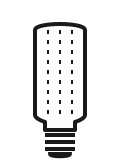
In commercial and municipal applications, 250W Metal Halide fixtures are typically deployed in warehouses, manufacturing floors, gyms and indoor sports courts, and medium-height high bays. The physical envelope corresponds to ED28 bulb with an E39 mogul base.
System draw drops from about 290W to 90–120W. Over 50,000 hours of operation, a single 250W MH retrofit saves roughly $1,200 in electricity at $0.13/kWh.
The ballast alone adds about 40W whenever the light is on.
Quick Reference: 250W Metal Halide Lamp vs. LED Replacement
| Spec | 250W Metal Halide lamp | LED replacement |
|---|---|---|
| ANSI ballast code | M58 (probe-start) or M138 (pulse-start) | None (ballast removed) |
| Bulb & base | ED28 bulb with an E39 mogul base | Corn bulb on the same base, or an integrated fixture |
| Light output | 21,000 initial / 14,500 mean lm | 14,500 lm target |
| Power at the meter | ~290W including ballast | 90–120W |
| Color | ~3,700–4,200K, CRI ~65–70 (ceramic MH: 80–90+) | 3000K–5000K, CRI 80–90+ |
| Rated life | 10,000–20,000 hours, varies by lamp | 50,000+ hours (L70), typical |
| Warm-up / restrike | 2–5 minutes / about 10–15 minutes | Instant |
What's Specific to the 250W Metal Halide Retrofit
Probe-start or pulse-start?
At 250W both versions are common: probe-start (ANSI M58) and pulse-start (M138). The lamps are not interchangeable on the same ballast, which matters if you need a stopgap lamp before converting. A Type B LED conversion removes the ballast, so the question goes away.
Gyms need guards and flicker-free drivers
In gyms and on indoor courts, choose LED high bays that offer wire guards against ball strikes. If games are filmed or streamed, look for drivers specified as flicker-free so the lights don't strobe on slow-motion phone video.
Confirm your voltage
Industrial metal halide fixtures are frequently wired at 208, 240, or 277V, and some plants use 480V. Most LED products accept 100–277V; 480V circuits need a product specifically rated for 347–480V.
Sizing From Delivered Light (Worked Example)
The 14,500 lm target above is a lamp-for-lamp match, which is the safe choice for a screw-in corn bulb. If you are replacing the whole fixture, you can often target fewer lumens. HID lamp ratings describe the bare lamp, and part of that light is lost inside the housing and reflector, while LED fixture ratings are measured for the complete fixture (IES LM-79 absolute photometry).
Example: if your existing fixture is 70% efficient, it delivers about 10,200 lm. An LED fixture producing 10,200 lm at 130 lm/W draws about 80W, versus ~290W today. Treat this as an estimate; the fixture maker's photometric report or a lighting layout is the authoritative answer.
5. Commercial Installation: Type B Ballast-Bypass Protocol
For maximum electrical efficiency and long-term reliability, a Type B (ballast-bypass) conversion is standard engineering practice:
- Disconnect Power: Lock out and tag out the circuit breaker supplying the lighting circuit.
- Bypass the Ballast: Disconnect the incoming line voltage (120–277V) and neutral wires from the legacy magnetic or electronic ballast. Cut or remove the ballast entirely, along with the ignitor and capacitor if the fixture has them (an ignitor left in the circuit sends high-voltage pulses that can destroy an LED driver).
- Wire Directly to Sockets: Connect line voltage directly to the socket leads according to the manufacturer's installation diagram.
- Label the Fixture: Affix the provided warning label inside the fixture housing indicating that the fixture has been modified to run line voltage and will no longer accept legacy Metal Halide lamps.