

Engineering Analysis: 400W High-Pressure Sodium to LED Commercial Retrofit
Upgrading a commercial or industrial facility from 400-watt High-Pressure Sodium fixtures to solid-state LED systems delivers exceptional return on investment. With commercial utility rate structures, demand charges, and continuous 12-to-24 hour operational schedules, lighting retrofits frequently achieve full capital payback in under 12 to 18 months.
1. Initial vs. Mean Lumens: Why the Target Is 45,000 lm
A 400W High-Pressure Sodium lamp is rated at about 50,000 initial lumens, but averages roughly 45,000 mean lumens over its life, a 10% decline while still drawing full power. HPS holds its output better than most HID sources, so the gap is relatively small; its bigger weakness is color (CRI around 20–22). Quality LED products are rated by L70 (hours until output falls to 70% of initial), commonly 50,000 hours or more. That is why this page targets 45,000 mean lumens (real-world working light) rather than the initial rating.
2. Hidden Ballast Load
HID lamps cannot run directly on line voltage; they need a ballast (typically magnetic) to start and regulate the arc. For a 400W High-Pressure Sodium lamp, the ballast adds about 65W (16%), so the fixture draws roughly 465W at the meter. Converting to direct-wire Type B LED hardware removes the ballast completely, cutting demand from 465W to 250–350W.
3. Commercial Facility Savings & Demand Charge Reductions
Operating on an industrial duty cycle of 12 hours per day, 365 days per year:
- Single Fixture Energy Reduction: Upgrading one socket eliminates 722.7 kWh of electricity annually, saving $93.95/year per luminaire.
- Facility-Scale Impact (25 Fixtures): Upgrading a bank of 25 fixtures cuts annual facility electricity overhead by $2348.75 every year.
- Zero Re-Lamping Maintenance: High-bay, canopy, and pole fixtures require bucket truck or scissor lift rentals costing $500–$1,200 per service call. With a 50,000-to-100,000 hour commercial lifespan, LED upgrades eliminate recurring maintenance cycles for 10+ years.
- Faster Recovery After Outages: An HPS lamp needs roughly a minute to cool before it will restrike after a power interruption, then several minutes to reach full brightness. LEDs come back instantly at full output.
4. Primary Applications for 400W High-Pressure Sodium Retrofits
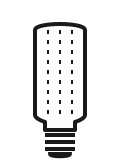
In commercial and municipal applications, 400W High-Pressure Sodium fixtures are typically deployed in highway interchanges, large parking lots, ports and freight yards, warehouse high bays, and hobby greenhouses. The physical envelope corresponds to ED18 bulb with an E39 mogul base.
A 400W HPS system pulls about 465W continuously. A lamp-lumen match is 250–350W of LED; integrated LED fixtures with directional optics are often sized lower for the same light on the ground.
Many utility rebate programs require the replacement LED to be listed on the DesignLights Consortium (DLC) Qualified Products List, so check the listing before you buy.
Quick Reference: 400W HPS Lamp vs. LED Replacement
| Spec | 400W HPS lamp | LED replacement |
|---|---|---|
| ANSI ballast code | S51 | None (ballast removed) |
| Bulb & base | ED18 bulb with an E39 mogul base | Corn bulb on the same base, or an integrated fixture |
| Light output | 50,000 initial / 45,000 mean lm | 45,000 lm target |
| Power at the meter | ~465W including ballast | 250–350W |
| Color | ~2,000–2,100K, CRI ~20–22 | 2700K–5000K, CRI 70–80+ |
| Rated life | 24,000+ hours | 50,000+ hours (L70), typical |
| Warm-up / restrike | Several minutes / about 1 minute | Instant |
What's Specific to the 400W HPS Retrofit
Claim the rebate
At 400W, rebates can cover a meaningful share of fixture cost. Most commercial programs require a DLC-listed product: verify the exact model on the DLC Qualified Products List and look up your utility's program in the DSIRE incentives database before ordering.
If it's a grow light, ignore lumens
A 400W HPS over plants should not be replaced by lumen-equivalence. Plants respond to photosynthetic photon flux (PPF, measured in µmol/s), and lumens are weighted for human vision. Compare LED grow fixtures by PPF and efficacy (µmol/J); the DLC Horticultural list publishes both.
Add controls while you're up there
Because HPS takes minutes to restrike and warm up, warehouse and yard HPS fixtures usually burn all night whether anyone is there or not. LED fixtures with built-in occupancy sensors or 0–10V dimming can drop to low output when aisles or lots are empty, adding savings on top of the wattage reduction.
Sizing From Delivered Light (Worked Example)
The 45,000 lm target above is a lamp-for-lamp match, which is the safe choice for a screw-in corn bulb. If you are replacing the whole fixture, you can often target fewer lumens. HID lamp ratings describe the bare lamp, and part of that light is lost inside the housing and reflector, while LED fixture ratings are measured for the complete fixture (IES LM-79 absolute photometry).
Example: if your existing fixture is 70% efficient, it delivers about 31,500 lm. An LED fixture producing 31,500 lm at 130 lm/W draws about 240W, versus ~465W today. Treat this as an estimate; the fixture maker's photometric report or a lighting layout is the authoritative answer.
5. Commercial Installation: Type B Ballast-Bypass Protocol
For maximum electrical efficiency and long-term reliability, a Type B (ballast-bypass) conversion is standard engineering practice:
- Disconnect Power: Lock out and tag out the circuit breaker supplying the lighting circuit.
- Bypass the Ballast: Disconnect the incoming line voltage (120–277V) and neutral wires from the legacy magnetic or electronic ballast. Cut or remove the ballast entirely, along with the ignitor and capacitor if the fixture has them (an ignitor left in the circuit sends high-voltage pulses that can destroy an LED driver).
- Wire Directly to Sockets: Connect line voltage directly to the socket leads according to the manufacturer's installation diagram.
- Label the Fixture: Affix the provided warning label inside the fixture housing indicating that the fixture has been modified to run line voltage and will no longer accept legacy High-Pressure Sodium lamps.